Rules
How to play Wordfray
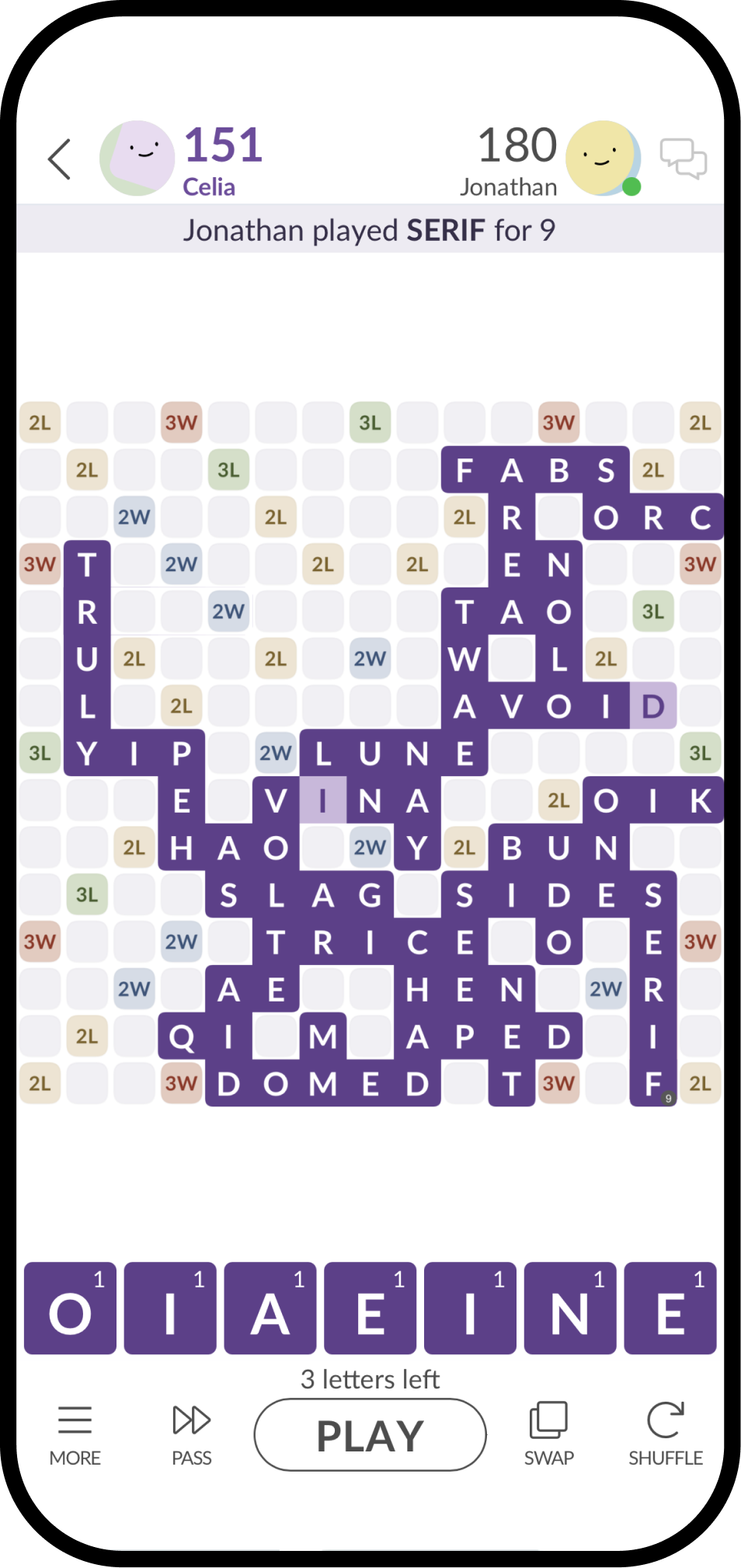
Wordfray is a crossword-style word game for two players. You take turns placing letter tiles on a 15×15 board to make words that connect to the words already there. Every letter has a point value, bonus squares multiply it, and the higher score at the end wins. Here are the complete rules.


Free on iPhone, iPad and Android · no account needed · no ads
The rules in 30 seconds
- Two players, a 15×15 board and 100 letter tiles. You hold seven at a time.
- On your turn, place a word across or down that joins the words on the board. The first word covers the center star.
- Each letter has a point value. 2L and 3L squares double or triple a letter; 2W and 3W squares, the whole word.
- Use all seven tiles in one move for 50 extra points.
- Stuck? Swap tiles or pass. The game usually ends when the bag is empty and a player uses their last tile; the higher score wins.
The goal
Score more points than your opponent. You score by building words from the seven tiles on your rack. When the game ends, the player with more points wins; equal scores are a draw.
Starting a game
You can play another person or the computer. To find a person, invite a friend with a link, look up a player by username, join an open table, or ask for a random opponent. A random game puts you at the newest open table, skipping players you've played recently; if no table is open, Wordfray opens one for you and you wait for someone to join.
Games between people come in two speeds:
| Classic game | Quick game | |
|---|---|---|
| Time limit | 1, 2 or 3 days per move (3 by default) | 3, 5, 7, 10, 15, 20, 30 or 60 minutes per player for the whole game |
| Running out of time | You lose the game | You can't move again; your opponent can keep playing until their clock runs out too |
You can have as many classic games going at once as you like. Against the computer, pick Easy, Medium or Hard, and choose the word list: US, UK, Canadian or Australian English. Games between people use the US list.
Your turn
On each turn you do one of three things: play a word, swap tiles, or pass.
Play a word
- Put one or more tiles in a single row or a single column.
- Leave no gaps: your tiles, together with any tiles already in that line, must form one unbroken word.
- Connect to the board: at least one of your tiles must sit right next to a tile that is already there (above, below, left or right).
- The first word of the game must cover the center star and use at least two tiles.
- Every word your tiles make, across and down, must be in the word list. A word has at least two letters.
After you play, you draw from the bag until you have seven tiles again, while tiles last.
Swap tiles
Put back one or more of your tiles and draw the same number of new ones. You score nothing for the turn. You can swap only while the bag still holds at least seven tiles. The new tiles are drawn before yours go back, so you can't draw back the ones you returned.
Pass
Skip your turn and score nothing. Four passes in a row, counting both players, end the game. A swap doesn't count as a pass.
Scoring
Your score for a move is the sum of the letter values in every word you made, with the bonus squares under your new tiles applied. Use all seven tiles in one move and you get 50 extra points.
Letter values
| Points | Letters |
|---|---|
| 0 | Blank |
| 1 | A, E, I, L, N, O, R, S, T, U |
| 2 | D, G |
| 3 | B, C, M, P |
| 4 | F, H, V, W, Y |
| 5 | K |
| 8 | J, X |
| 10 | Q, Z |
Bonus squares
The board has 64 bonus squares in its own layout: 8 triple word, 16 double word, 12 triple letter and 28 double letter squares. The corners are double letter squares. The center square has no bonus, but double word squares sit two squares from it in each direction, so a five-letter first word can cover two of them.
How bonuses add up
- A letter bonus (double or triple letter) multiplies only the tile placed on it.
- A word bonus (double or triple word) multiplies the whole word, after letter bonuses.
- Two word bonuses in one word multiply each other: two double word squares make ×4, a double and a triple make ×6, two triples make ×9.
- Bonus squares count only on the move a tile is placed on them. Later words that use that tile score its plain value.
- If your tiles make more than one word, each word scores. A new tile on a bonus square counts its bonus in every word it is part of.
- The 50 points for using all seven tiles are added at the end and are not multiplied.
- A blank scores 0, even on a letter bonus, but a word bonus under it still multiplies the word.
A worked example
Three moves from the start of a game, scored with the real board and letter values:
| Move | Where the tiles go | Score |
|---|---|---|
| 1. JOKER across the center | J on the double word square two left of the star, K on the star, R on the double word square two right of it. Two double word squares: ×4. | (8 + 1 + 5 + 1 + 1) × 2 × 2 = 64 |
| 2. HARES down through the R | H and S land on double letter squares. The R was already there, so its double word square does not count again. | (4 × 2) + 1 + 1 + 1 + (1 × 2) = 13 |
| 3. SIX across, above the H | The S turns HARES into SHARES, so both words score. The I sits on a double word square, which doubles SIX only. | SIX (1 + 1 + 8) × 2 = 20, SHARES 1 + 4 + 1 + 1 + 1 + 1 = 9: total 29 |
Had the game opened with seven tiles instead, say PLAYERS with the A and the S on the two double word squares, the move would score (3 + 1 + 1 + 4 + 1 + 1 + 1) × 4 = 48, plus 50 for using all seven tiles: 98 points.
The tiles
There are 100 tiles: 98 letters and 2 blanks, worth 187 points in all. Each tile below shows its points and how many are in the bag.
- A1×9
- B3×2
- C3×2
- D2×4
- E1×12
- F4×2
- G2×3
- H4×2
- I1×9
- J8×1
- K5×1
- L1×4
- M3×2
- N1×6
- O1×8
- P3×2
- Q10×1
- R1×6
- S1×4
- T1×6
- U1×4
- V4×2
- W4×2
- X8×1
- Y4×2
- Z10×1
- 0blank ×2
| Tiles per letter | Letters |
|---|---|
| 12 | E |
| 9 | A, I |
| 8 | O |
| 6 | N, R, T |
| 4 | D, L, S, U |
| 3 | G |
| 2 | B, C, F, H, M, P, V, W, Y and the blank |
| 1 | J, K, Q, X, Z |
A blank can stand for any letter you choose and keeps that letter for the rest of the game. It is worth 0 points. Blanks are the most flexible tiles in the bag, which makes them valuable for seven-tile moves.
Valid words
A word counts if it is in the game's word list. Wordfray has four English lists: US, UK, Canadian and Australian. They are built from SCOWL, an open English word list, not from the official tournament lists, so some words may differ from other games. The US list has 78,998 words of two to eight letters.
- As you place tiles, a valid word lights up on the board before you play it. There is no challenging: a word that isn't in the list simply can't be played.
- You can open any word on the board to see two of its meanings and where they come from.
- Two-letter words are the most useful to learn. The US list has 119 of them, the other lists 114. All four lists also accept some units and abbreviations, such as CM, KG and OZ. See all valid two-letter words.
End of the game
A game ends when:
- the bag is empty and one player has used all their tiles;
- there have been four passes in a row;
- in a quick game, both players' clocks have run out;
- a player resigns (the other player wins);
- in a classic game, a player doesn't move in time (that player loses).
Leftover tiles: when a game ends by play (a player goes out, four passes in a row, or both clocks run out), the points on each player's remaining tiles come off that player's score. A resignation or a missed deadline simply decides the winner. If one player has used all their tiles, the points left on the opponent's rack are also added to theirs. For example, if you play your last tile while your opponent still holds a K and an E, they lose 6 points and you gain 6.
The higher score wins. Equal scores are a draw.
Quick reference
| Rule | In Wordfray |
|---|---|
| Players | 2 |
| Board | 15×15 squares; the first word covers the center star |
| Tiles | 100: 98 letters and 2 blanks; 7 on your rack |
| Bonus squares | 8 triple word, 16 double word, 12 triple letter, 28 double letter |
| All 7 tiles in one move | +50 points |
| On your turn | Play a word, swap tiles (while at least 7 are in the bag) or pass |
| Classic game | 1, 2 or 3 days per move |
| Quick game | 3 to 60 minutes per player for the whole game |
| Computer | Easy, Medium or Hard |
| Word lists | US English for games between people; US, UK, Canadian or Australian against the computer |
| Game ends | Bag empty and a player out of tiles, four passes in a row, both clocks out (quick), a resignation, or a missed deadline (classic) |
| Leftover tiles | When a game ends by play: subtracted from their owner, added to the player who went out |
Ready to score more? Read the strategy tips, learn the two-letter words, or find answers in the FAQ.
Play your first word